Pleromism
Plemorism is the theoretical framework described throughout the PowerMyth Index. Come back very soon for more...
(INTRO HERE)
1. POWER
Our lives are bounded by Power, the network of social boundaries that shapes what is possible. To know Power is to understand where and how it manifests.

We understand social boundaries because of the Power Conduits: cultures and the institutions that formalize their values. Our government, our relationships, our technology, and our language are all interrelated and bear influence on one another.
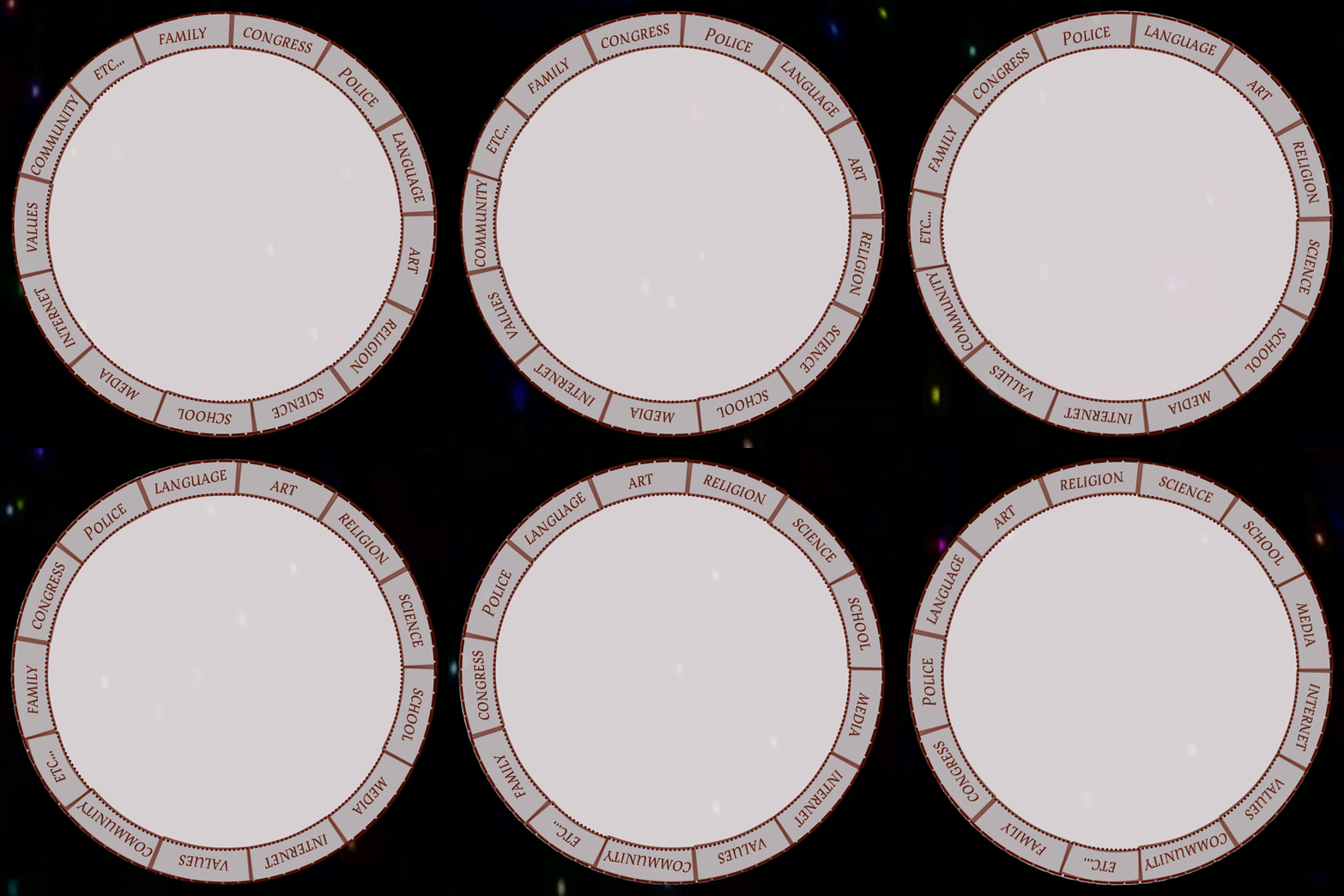
However, certain properties offer the potential to reshape those boundaries. These Power Capacitors, such as money, status, and information, can be accumulated under the right circumstances.

Capacitors can then be exchanged into active Power Negotiators, which are processes that target Conduits to either expand or contract the boundaries of possibility.

When the properties of a Negotiator are embedded in a Conduit, they are perpetually reflected back as Power Emitters. Passive effects from cultures and institutions, such as laws, norms, and customs, reproduce the Power that shaped them.

2. REALMS
The boundaries of possibility shaped by Power ultimately form each person's Realm of Freedom. This constitutes what can done without facing consequences, whether those consequences be moral, legal, or rational.

However, it would be exceedingly rare for any two Realms to be exactly alike. Though two individuals may share the same government, laws might apply to them differently. They may share a national culture while still having different religious beliefs, access to Capacitors, life experiences, and so on.

Those variations are embodied through fields of knowledge and behaviors called Mythoscapes. Mythoscapes are relationally defined and operate at the following levels:
- Self: characteristics and identity, such as race, class, gender, or age.
- Club: affiliations and community, such as region, occupation, or political party.
- World: purported universals, such as being, truth, or reality.
Mythoscapes generally come with their own set of Myths that help rationalize the world around us, each with unique stories of who should be disliked (The Villain) and who should be rooted for (The Hero). They also set the stage (The Setting) and describe what the heroes are up against (The Conflict).
The Mythoscapes that a person is either ascribed or subscribes to, perhaps unsurprisingly, are also unlikely to perfectly overlap. The process by which Mythoscapes are reconciled to form an individual Realm mirrors the process by which individual Realms are reconciled to form a collective Realm: Both levels see necessary exclusions, clear priorities, and some amount of unresolved squishiness.

When a collective forges a new Realm, the contradictions within result in some inherent instability. Excluded components have incentive to expand the boundaries, but constant negotiations threaten the Realm's composition. Therefore, taken-for-granted social forces known as Realm Enforcers prevent significant change from occurring:
- Monadus, the leader who defines the dominant position.
- Mithrot, the storyteller who imbues meaning in myths.
- Categorius, the evaluator who classifies information.
- Normaliza, the peacemaker who justifies the way it is.
- Distributon, the decider who allocates resources.
- Repressio, the silencer who prevents what is unacceptable.
(VIDEO HERE)